The first few months in a new leadership role are full of people who need something from you, problems that have been waiting for someone to solve them, and opportunities to demonstrate that you know what you're doing. Some of those problems are urgent, some are important, and some are simply familiar.
They don't necessarily arrive in that order.
When I first took over a business unit, I decided to impose some order of my own. I kept notes, drew process maps, and divided the first 90 days into three phases.
I've returned to that approach several times since. I've distilled this to seven questions to answer before deciding where to put time, people, and money. It's what I wish I'd known then - and how I help clients to prioritize resources.
1. What's the story you're walking into?
In the first two weeks, everybody will tell you why the business is where it is. The reps say it's pricing or competition or lack of leads. Operations says it's sales customizing everything. The last leader's notes say it's the market.
People who have lived with a problem for years often understand parts of it that won't appear in any report. They also have their own vantage points, incentives, and histories, which influence how they interpret what happened.
Write down the explanations (a doc where you document first impressions is invaluable), along with who offered them, and resist the temptation to turn any one of them into my own diagnosis. Then come back to that list somewhere between day 60 and 90 and ask which explanations have held up after watching the work happen. Sometimes it takes longer for some of the more persnickety dynamics to surface.
2. How does money come in?
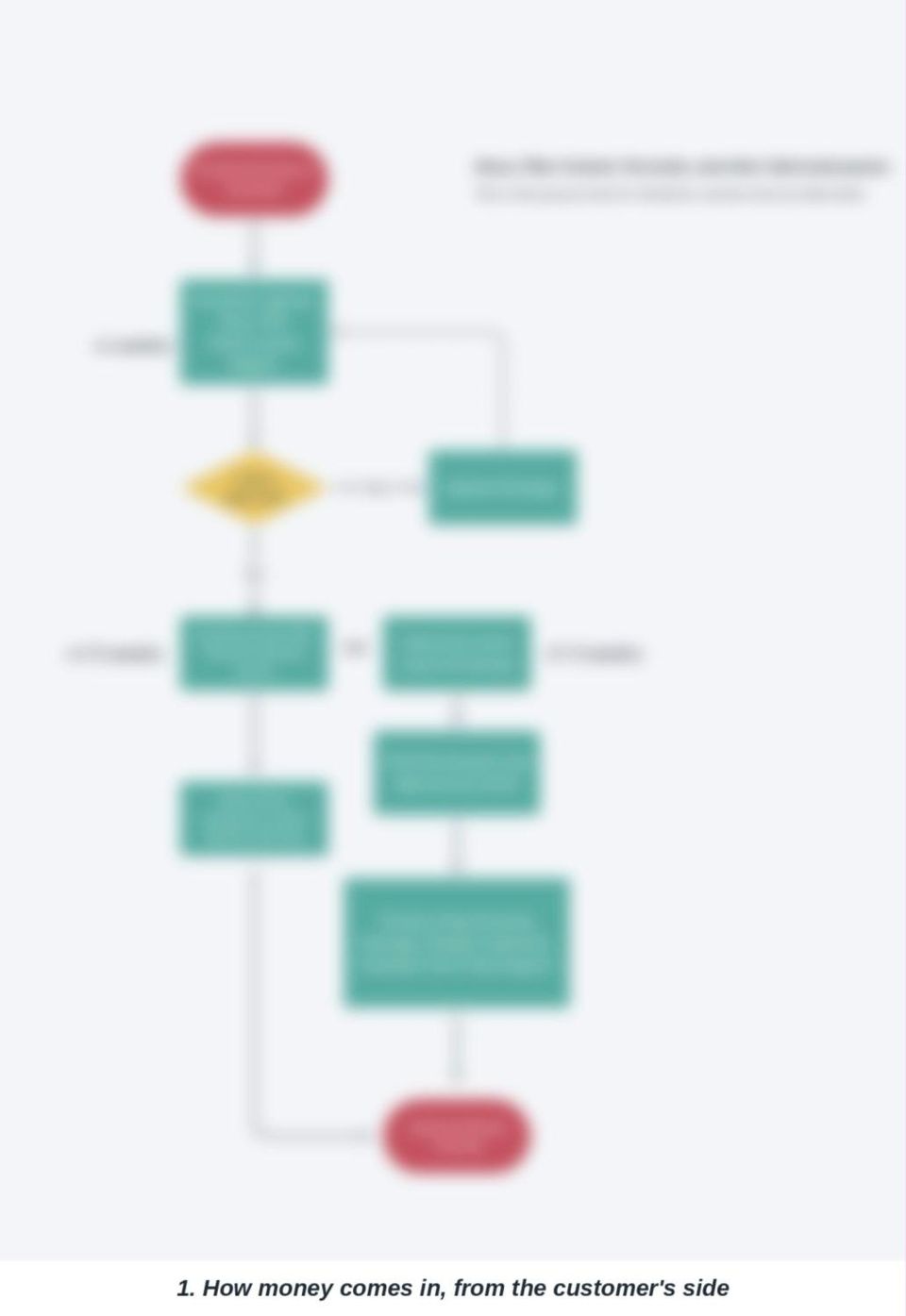
Map all the steps money has to take to arrive at your P&L's top line. Do this 2x.
First, from the customer's perspective. How do they get a rough order of magnitude estimate (do they even get one?), from there a more accurate estimate - who does the takeoffs, how are quantities estimated, what warm and fuzzies does the customer feel when a project or sale is moving along stages. Is it easy for them to pay or they have to accommodate to your company's crazy processes. In other words, how easy is it for them to give you money.
This is a real flowchart - so images are blurred for privacy. Notice all the steps a client has to go through to get this company paid!
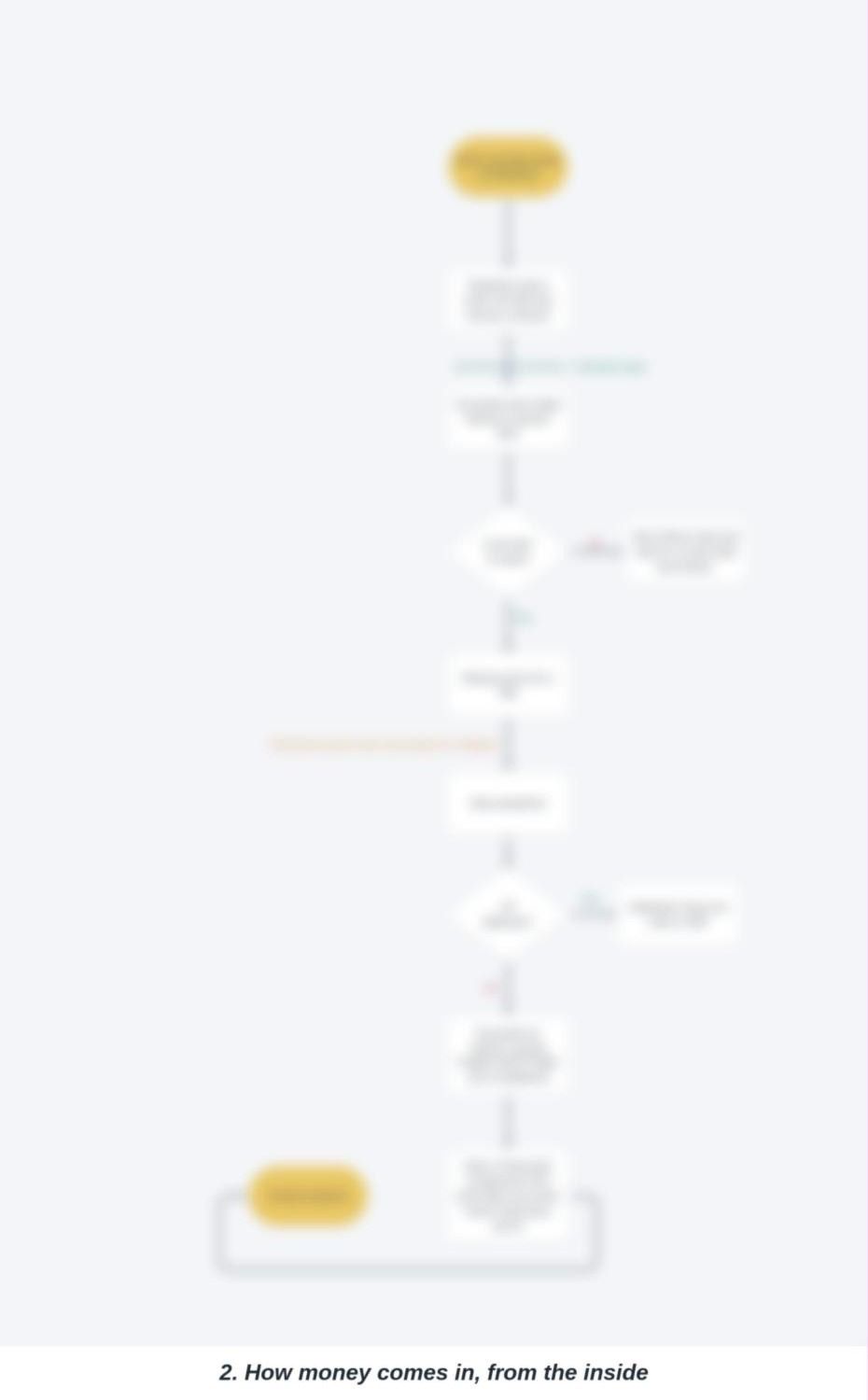
Then I'd map the same journey from inside the company.
How do you internally define a qualified opportunity, who prepares the quote, enters the order, checks inventory, arranges production or purchasing, coordinates delivery, handles exceptions, and makes sure the customer gets what was promised, when it was promised?
What happens at the handoffs. Do your internal processes and systems make it easy to invoice a customer?
Building products have complicated journeys because the person choosing the product isn't always the person buying it, and neither may be the person installing it. An architect can specify something a contractor doesn't want to use. A distributor can carry a product their salespeople don't understand. A manufacturer can ship an order successfully while the installer is still missing the information needed to put it on the wall.
Each department may have done their job correctly from inside the building products manufacturer, but from the customer's perspective, the experience could still have ended up a hot mess.
This is that same company's money path as seen from the inside. Even more complex.
You also want to be clear about when revenue is recognized in the company, is it when you get paid? or when the order ships? or when it delivers? or ?
You can't see any of that from the P&L. You have to follow one order all the way through.
3. Who owns what, and who is the hero?
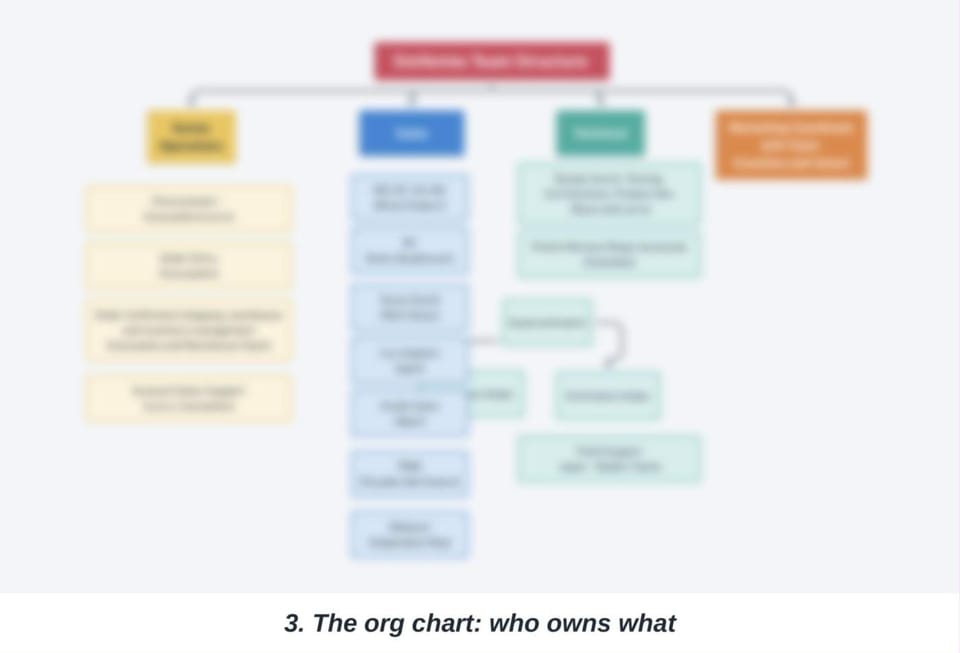
Right alongside the money maps build an org chart, and then a simple list of who owns what.
Real org chart - privacy blurs added
Who owns pricing? Who answers technical questions? Who manages samples? Who is in charge of procurement? Who solves the problem when an order is botched? Who maintains the relationships that matter to the business?
Once you have the full picture, look for the gaps. What essential work has no owner? And who is doing far more than their job description suggests?
Every building products business I've known has had its heroes. The rep who knows every architect in the territory. The technical person answering an installer's call before sunrise. The customer service employee who knows every ERP workaround and which shippers can be trusted. The one who raises a hand when everyone else says, "That's not my job." Maybe it's you.
These people are invaluable, but there's a difference between having great people and having a business that depends on them to function.
I'd ask what would stop if they took two weeks off. I'd also look at work handled by independent reps, distributors, and other partners. How much of the business depends on relationships and institutional knowledge that exist outside its systems?
And I'd put my own name on that chart.
I've caught myself taking on too much simply because I knew how to get it done. It feels productive, especially when the business is growing.
Until you realize you've become another dependency.
4. Do you have a squeaky wheel?
In most companies help goes to whoever asks loudest or whoever's work is easiest to see. The rep who complains the most gets the most technical support. The distributor with the biggest ask gets the best price.
Oftentimes, the territory or department that's really stuck is suffering in silence, because the people in it stopped asking or they stew as they watch other departments, team members, get better resources.
Don't let that happen under your watch. Learn to discern actual need from whining.
5. Does each role have clear metrics?
Is there a fair and reasonable number someone actually gets paid or reviewed on? Does it align with company's or business unit's goals and quotas? Check it for your direct reps, your independent reps, your distributor, your technical team, and your customer service.
People follow what’s measured, every time. A lot of leaders call that gaming the system. Gaming implies someone is cheating, when most of the time people are doing exactly what the system pays them to do, so the fix belongs to whoever designs and manages to the metric.
A rep paid on revenue can make their budget by discounting away profit. An independent rep paid only when material ships may favor an easy order over the specification work that takes two years to pay off. A technical team measured by closed tickets can clear its queue without resolving the problem on the job site. Anything can and will be gamed. Close rates, new projects, new accounts. Find the metrics that truly give you growth visibility in real time.
6. What are the company's blind spots?
If you inherited a new product line inside an established company, this one is for you.
What were the company's systems built to see?
A sales report can tell you exactly what shipped last month, but nothing about the projects where your product was specified and never purchased. A CRM can count architect presentations without telling you whether anyone followed those projects through to construction.
Look for the places where the business has changed but the systems haven't.
Does your company or product have a reputation that this business unit or new product launch conflicts with?
The same blind spot shows up with teams. Some manufacturers classify technical support as non-revenue generating so resources and appreciation are a fraction of say sales and marketing's. When a team's responsibility outruns what the company can see, it gets cut first and missed last.
7. Where do you keep wanting to jump in and help?
This question is just for you, the leader. Notice which problems you keep walking toward. If you came up through product, it'll be product. If you came from sales, it'll be the big deal, scripts, or how samples are delivered. If you're an engineer like me, it'll be the technical question nobody else can answer.
That pull is useful, because it tells you exactly where you're most likely to hide. You can still take a quick win there. Just don't let the place you're most comfortable become the only place you work.
How to pace your first 90 days
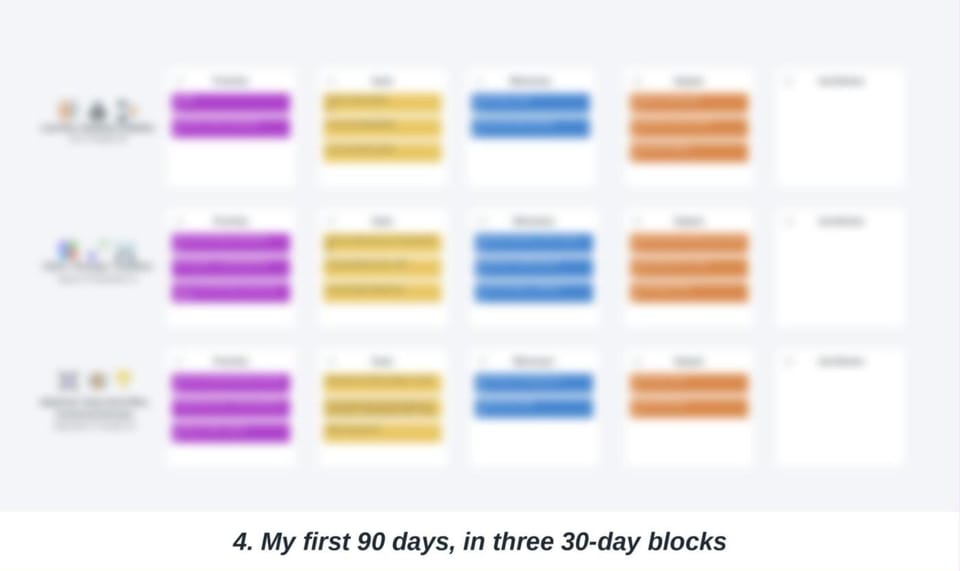
When I took over that business unit, I split my first 90 days into three blocks on a board, with no more than three priorities in each.
The first block was learning and building credibility: conversations, interviews, product understanding, the process maps. Its outputs were a diagnosis of the situation, the key priorities, and a plan for the next 30 days. The second block was vision, strategy, and alliances: teaming up with operations and the technical people, transitioning my direct reports, setting expectations and goals. The third was alignment, the team, and early wins: pipeline visibility, a vision for the new team, a phased strategy for the next year, and starting to hire.
Two things about that board I still use with clients.
Early wins go in month three, after you understand what a win is actually worth.
Every block ends with a review with whoever you answer to: your boss, your board, your owners. If that’s no one, pick someone you trust to tell you the truth, like an advisor, a peer, or your leadership team. That way there’s something real to show every month, long before the sales cycle can.
The order matters
None of this is about changing anything in the first weeks. Moving slowly costs you a little, and fixing the loud problem with the tool you're best at costs you a lot, because it teaches the whole company that this is how help gets handed out now.
Slow down to go fast. Get a clear visual of the system before you touch it.
YOUR TURN
I now build a 90-day plan for every new role, whatever the title, including my own.
Have you been in this position? What happened in your first 90 days that you’d want the next person to know? And is there a name that shows up in too many boxes on your org chart right now?
I’d love to hear your perspective in the comments, especially if you’ve been the new leader, the person who was there before, or the person everyone calls when something breaks.
Share this with someone you know who just stepped into a new seat. Even if it's past the first 90 days, all of these are good questions to reset.
Enjoyed this piece? Subscribe to Site Lines for more perspectives on what happens between the spec and the reorder.
Site Lines is written by Carolina Baffigo, principal at Spec to Scale. We challenge how building products are specified, sold, installed, and scaled.From website to job site.