The Stakeholder Most BPM Sales Teams Underestimate

There’s one stakeholder most BPM sales teams underestimate. And it’s the only one that can make your spec unkillable.
Last week I shared a framework for choosing your #1 stakeholder in building product sales. 3 tracks: Field, Spec, Hybrid. I teased a 4th and here it is.
Table of Contents
The Owner
Not “owner relationships” as a line item in your spec strategy. Not the annual lunch with a facilities director. A deliberate sales motion aimed at the people who pay for buildings, live with them for 30 years, and bear 100% of the lifecycle risk.
Premium Products
If your product has high CapEx but lowers OpEx over the building’s life, think high-performance envelopes, advanced HVAC, durable finishes, you have a math problem. The architect specs on performance. The GC value-engineers on first cost. And just like that, you’re out.
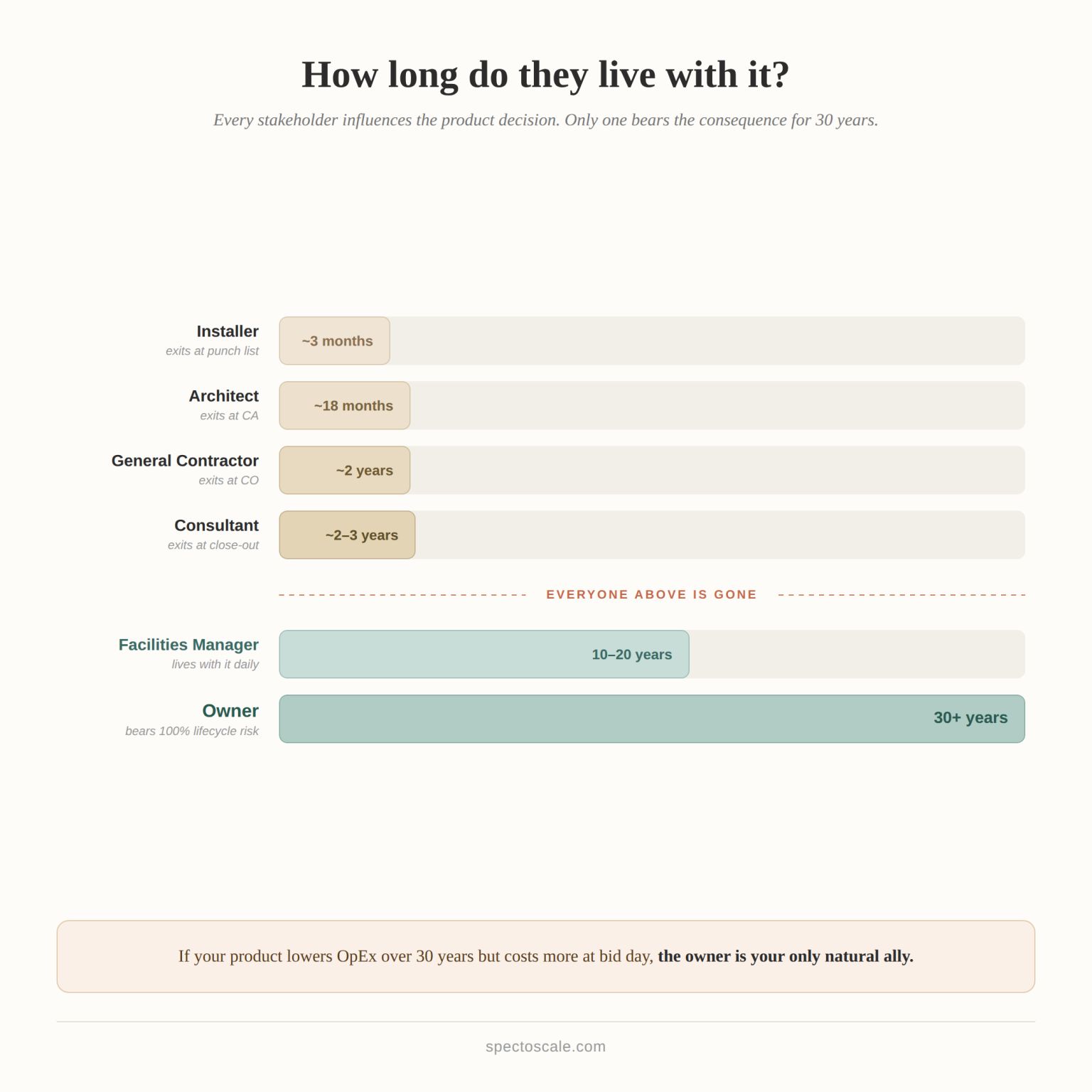
The owner is the only stakeholder whose economic horizon matches your product’s value proposition. They’re the one who pays the energy bills in year 7. They’re the one who funds the re-roof in year 15. They’re the one who eats the warranty claim the GC walked away from. When an owner understands total cost of ownership, your premium isn’t a barrier. It’s an investment thesis.
Getting Access
Here’s how to actually get in front of them:
- Stop selling product. Start selling risk reduction and operating cost data.
- Learn to speak portfolio, not project. Owners with 20 buildings don’t care about one spec section. They care about what performs across all 20.
- Target the asset manager and the facilities director, not just the development PM. The PM’s job ends at CO. The FM lives with your product forever.
- Bring warranty and maintenance data to the table, true LCAs, not just test reports. ASTM numbers get you specified. Field performance data gets you required.
But getting the ear of an owner has been nearly impossible to execute until now. And the data infrastructure to make direct-to-owner viable is being built as we speak. If you’re struggling to unlock revenue growth because of value engineering, this shift matters for you.
What’s Next
The owner is the stakeholder whose timeline matches your product’s value. They bear 100% of the lifecycle risk. They’re the only natural ally for premium products that cost more upfront but deliver long-term savings. And avoiding data center blind spots in your approach means understanding this dynamic.
When you stop selling to stakeholders who exit at punch list or CO, and start selling to the ones who live with your product for 30 years, your premium becomes an investment thesis instead of a barrier.
Sign up for the newsletter to catch the two-part series on what’s changing and exactly what it means for building product manufacturers.