You won the #adoption gap. Then you started funding its death. The renewal gap is the bill coming due, and by the time it shows up in the numbers, it's the next leader's problem. Here is how you keep that from happening to you, or how to get out of the hole if you're finding yourself in it now.
Most building products are designed to last decades. The companies that make them are rewarded on the quarter.
Two clocks. One runs in years, the other in ninety-day increments. The risk lives in the gap between them, and it usually gets noticed too late to do anything about it.
Founders, CEOs, and business unit leaders are asked to grow products and protect budgets inside relatively short tenures. The average Fortune 500 CEO stays in the role around seven years, according to Spencer Stuart. Inside that window the incentives are obvious. Make the numbers look good. Show the company trending the right way. Convince the board the strategy is working.
So we sacrifice the decade for the quarter.
And the cost doesn't land right away. You brush the problem under the rug, the numbers hold, you move on, and by the time it starts to smell you're already three roles down the road.
I've spent two decades in and around building products, watching the same pattern repeat across very different companies. What follows is composited from about fifteen of them into three case studies, because the failure is almost never one bad actor. It's systemic. And it's preventable.
I call the distance between those two clocks the renewal gap: the widening space between how long a product physically lasts and how long the reasons people chose it stay true. By the time it shows up in the numbers, it's already years deep. It takes about that long to undo. Which means it almost always becomes the next leader's turnaround.
The renewal gap
A building product has a long physical life. The customer's attention does not.
Specifiers spec what feels current. Reps sell what feels alive. Distributors stock what moves.
None of those words, current, alive, moving, are properties of the product. They're properties of a company still behaving as if the product were being invented, improved, and re-earned in the market every day.
That behavior costs money. Training. Field presence. R&D. Samples. Showrooms. Technical support. The selling story itself.
Every one of those line items is easy to call discretionary, and therefore easy to cut. Worse: cutting them can make the quarter look better.
So they stay vulnerable, year after year, to the most reasonable question in any budget meeting. Why are we still spending on this? What are we getting out of it?
The honest answer rarely survives the meeting, because the expense is visible now and the consequence of cutting it is not. The quarterly report documents the savings. It does not record the rep becoming less useful, the architect becoming less curious, the distributor losing urgency, the technical team losing its institutional memory, or the applications the company is no longer equipped to pursue.
Those losses don't show up on the balance sheet. The company improves its margin while consuming capabilities built by someone else's earlier investment. It's borrowing from future relevance, booking the savings today, and leaving the repayment to whoever comes next.
That's renewal debt: what a company runs up when it consumes the capabilities that keep a product relevant without replenishing them.
A company can look profitable while becoming less capable. The two aren't in tension. That's exactly what makes it dangerous.
The renewal gap shows up in three ways
1. Saturation drift
The first company won so completely that dominance started to look like relevance. The product was everywhere. On every job. On Instagram, with influencers. In what felt like every market. Brand recognition, distribution, specifications, years of accumulated trust.
Then something subtle changed.
Customer conversations became confirmations instead of investigations. Market share became the answer to every uncomfortable question. The organization stopped asking what was changing, because the numbers still suggested nothing had to.
Training continued. It mostly repeated what everyone already knew. The product kept selling, but fewer people inside the company could explain why the next generation of customers should care.
It had the largest presence in the market and one of the weakest sensing systems in it.
Saturation drift is what happens when a company wins so completely that dominance starts to look like relevance, and market penetration quietly conceals declining curiosity. The product becomes wallpaper. On every job, in every market, and somewhere inside that success the organization stopped asking what comes next.
Saturation is not a finish line. It's a slow failure wearing the costume of a win.
2. Incremental defunding
The second company didn't stop renewing itself in one dramatic decision. It happened one reasonable cut at a time.
The training program, in a soft quarter. The field support roles, when margin slipped. The showroom cycle, when Q1 came in under plan. A research initiative that couldn't prove near-term revenue. A technical position left unfilled, because the team could absorb the work.
Each cut could be defended as disciplined capital allocation. None looked big enough to threaten the business on its own.
The numbers improved. The system weakened.
Over time the company lost the people who translated field conditions into product decisions. Reps had fewer reasons to go back to architects. Technical knowledge concentrated in a shrinking number of heads. Fewer new applications entered the pipeline. Nothing collapsed, which would have made the problem easier to see. The company simply lost its capacity to create the next reason to be chosen.
By the time revenue softened, the cuts responsible were several budget cycles old, and the leaders who made them were gone.
Incremental defunding is the dismantling of renewal one defensible reduction at a time. It's the most common pattern and the hardest to catch in real time. Rational at the quarter. Fatal at the decade.
3. Cosmetic refresh
The third company looked like it was constantly innovating. New finishes. New collections. New offerings. A showroom that turned over every season. The launches kept coming.
R&D, training, technical support, and field investment stayed flat.
From the specifier's chair, theater and the real thing look identical for about two cycles. After that, the absence underneath starts to show up exactly the way decline does. The rep walks into the same conversation as last year. The spec calls get shorter. The new collection creates attention but no new reason to believe.
Cosmetic refresh is renewal's costume without its substance, and it's the sneakiest of the three because it manufactures evidence that renewal is happening. The dashboard is green. Launches, campaigns, color additions, a redesigned website. But nothing underneath has moved.
Nothing got easier to specify. Nothing got easier to install. The field team knows nothing it didn't know two years ago. No new customer problem got solved.
So when you ask what changed underneath the showroom, and the answer is new colors and a new brochure, the company refreshed its appearance. Not its capabilities.
Adoption is not permanent
Here's the assumption underneath all three failures: that adoption happens once.
A product becomes known. It gets specified. Contractors learn to install it. Distributors stock it. The market accepts it. And then the company starts behaving as if the work is finished.
This is where I have to connect two ideas, because they're halves of the same story.
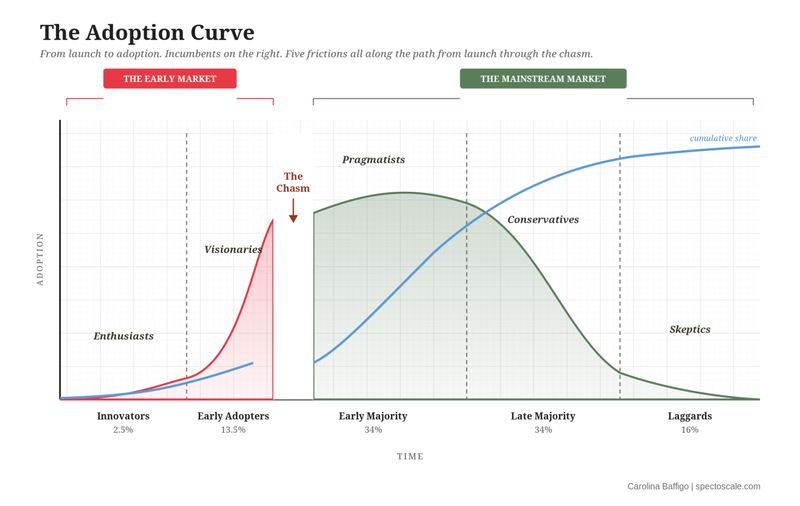
The first half is the adoption gap: the distance between a genuinely good product and the market actually choosing it. Closing it is brutal work. Tooling, certifications, rep training, spec relationships, years of showing up. Most companies reading this won that fight. They earned their place on the wall.
The adoption gap is that chasm to cross to get to mainstream.
The second half is the part nobody warns you about. Adoption is not a one-time win. It's recurring social permission, and permission has to be renewed.
The product gets reauthorized every time a new architect joins the firm, an experienced installer retires, a code changes, a competing system shows up, a distributor reshuffles priorities, or a new aesthetic vocabulary takes hold. The renewal gap opens the moment a company stops re-earning the permission it already won.
You won the adoption gap. The renewal gap is what happens when you let that win quietly expire.
The panel may last forty years. The reasons people chose it may last four. Physical durability disguises social expiration. A company can keep producing exactly what it always produced while the market quietly withdraws the assumptions that made it successful in the first place.
Evolve the product, or lose it
You invested in the tooling, the certifications, the training, the spec relationships. Undermining that feels insane.
So let me be precise. "Kill the product" does not mean discontinue it. It means kill the version of the product that has stopped evolving, before the market kills it for you.
Kill the obsolete assumptions before they kill the product. The finish. The message. The application. The channel assumption. The belief about who buys it. The job it was hired to do. The failure it solved ten years ago that nobody has anymore. The competitive landscape that's quietly strangling its share.
Evolving a product rarely means reformulating it from scratch. More often it means going back to the assumptions it was built on and checking whether they still hold.
Who's the buyer now? What risk are they trying to avoid? What application is growing? What part of installation still creates friction? What does the rep need to be able to explain today that wasn't necessary five years ago? What new reason does the customer have to re-engage?
A fresh finish doesn't touch any of that.
Renewal is not innovation
Part of the problem is the language.
Innovation sounds like invention. Novelty. Moonshots. Entirely new products. Which makes it easy to classify as optional, especially in a soft year.
Renewal is broader and more practical. It's the work of staying chosen. Improving the existing offer. Rebuilding field confidence. Updating technical knowledge. Changing the selling story. Addressing a new application. Retiring an obsolete assumption. Making the product easier to specify, buy, install, or defend.
A company doesn't need constant novelty. It needs continued evidence that it's still learning.
Who champions the next decade?
This is the governance question building products companies neglect to make explicit. Different roles get pulled toward different horizons.
Commercial leaders protect current revenue. Operations protects execution. Finance protects margin, cash, and EBITDA. Boards oversee risk, capital, and enterprise value.
Every one a real job, done by capable people. And not one of them owns the long game. We're all reviewed on the metrics for today, for good reason. So the problem isn't that nobody cares about the future. It's that the future has no internal mechanism to protect it.
Ideas get shot down because the existing product still sells. Leaders get attached to products that are near and dear to the owner's heart. Investments in renewal get evaluated on the same time horizon as ordinary operating expense. Field intelligence reaches leadership only after it's been sanitized into something easy to ignore.
The danger isn't one anti-innovation executive making one terrible call. It's a governance system that lets capable people improve quarters by giving up the decade.
There's a successor problem hiding in here too. The leader who makes the cut collects the benefit. The leader who inherits the business collects the consequence. One executive gets praised for margin discipline. Their replacement gets handed a turnaround.
So the better question isn't whether a leader grew revenue or improved EBITDA. It's whether they left the company more capable than they found it. Are we improving the business, or just consuming what previous leaders built?
The quarter has plenty of defenders. The decade usually has good intentions and an empty chair.
And that chair cannot be filled by one unusually courageous executive. No individual can own the decade alone. The governance system has to.
The questions that surface it fast
If you want to know where your own company sits, a handful of questions get you there quickly.
Product. What has materially improved in the offer in the last 24 months?
Field. What can your rep say today that they couldn't say two years ago?
Capability. Which training, research, technical, or field capabilities are being expanded, not just maintained?
Customer. What new reason does an architect, contractor, or distributor have to re-engage?
Governance. Which investments are protected from normal quarterly reduction, and who has the authority to defend them?
Learning. What has the company learned recently that changed an important assumption?
The last one is my favorite.
If the answers are mostly new colors, new brochures, and a redesigned showroom, the refresh is too superficial.
What actually prevents it
Companies don't prevent decline with more innovation speeches, committees, launch events, or heroic budget fights. They prevent it by making renewal structural.
That means defining which capabilities have to keep advancing. Separating the cost of operating the current business from the cost of keeping that business relevant. Protecting a portion of the budget from short-term erosion. Periodically returning to the assumptions underneath the product to check whether they still hold. And measuring what actually changed beneath the visible refresh.
Not how many collections launched. What became easier to specify, install, sell, or defend. Not how many training sessions happened. What the field can now do that it couldn't before. Not how modern the showroom looks. What the company learned about the customer.
A serious renewal mechanism needs at least four things:
Protected capabilities. Name the research, training, technical, field, and market-sensing capabilities that can't be treated as ordinary discretionary spend.
Assumption review. Periodically revisit the buyer, application, installation method, channel, competitive set, and customer problem the offer was built on.
Renewal indicators. Track what changes beneath the visible refresh: new applications, improved installation, spec re-engagement, field competency, channel expansion, technical learning.
Clear authority. Someone has to be able to defend these investments, and the system has to require a higher bar of scrutiny before they're cut.
The decade doesn't need a ceremonial owner. It needs authority, funding, memory, and a mechanism that survives a change in leadership.
The danger was never one bad decision. It's the compounding effect of good decisions made inside too narrow a time horizon. A company's future is rarely destroyed by leaders who don't care. It's depleted by capable leaders who got rewarded for decisions whose consequences matured after they left.
Building products may last forty years. Relevance does not.