Performance management systems were not designed to protect your team. They were designed to protect your company from being sued by the person you are trying to fire. Those are not the same problem.
In recent conversations with podcast guests and leaders I work with, I have started calling this pattern the underperformance contagion. I have lived it myself. Here is the most recent version, with names changed, from a leader I work with. The shape of it is so common you will probably recognize it before I am halfway through.
This leader inherited a long-tenured, once-productive team member who had decided somewhere around year twenty that the job should come to him instead of the other way around. He stopped making calls. He stopped leaving his house to see customers. He stopped doing, essentially, the work the job description called for. Doing less than the minimum so the rest of the team had to work harder to cover the work he was passing on.
What HR tells you to do
“Have a direct conversation with the employee. Tell them what you are seeing.” She did that.
“Set expectations.” Done.
“Document the gap between the role and the performance.” Did that, too.
This manager went further. She offered support and coaching. She asked if something in this man's personal life was making the work feel impossible. Young though she was, this manager was still naive enough to believe in giving the guy a chance to rediscover whatever had once made him good at his job.
None of it worked. She escalated to her supervisor and recommended the company let the employee go before the team's morale dropped further.
This is when HR tells you to build the file. Document emails, conversations, absenteeism, missed metrics. Especially if the employee is in a protected class.
The manager has no choice but to slow down and follow the process. Weeks become months. HR insists this is the responsible timeline. She had the paperwork drafted in March. Legal cleared it in September.
By the time the file was thick enough to act on, team morale had gotten so low two of her strongest reps were already in third-round interviews at her biggest competitor.
The manager did everything right. She followed the process. And she lost the team anyway.
What management training does not teach you
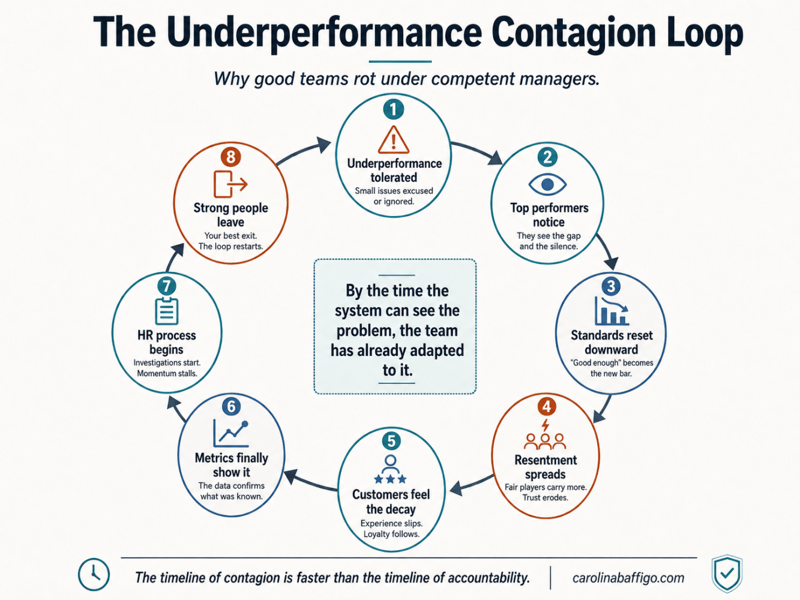
The timeline of accountability is slower than the timeline of contagion.
While you are building the case, the case is spreading. The strongest performer on the team starts wondering why she is working this hard when the guy down the hall is working that little for the same money. Sometimes more. The next-strongest does the math on what he can get away with. A third person, always a little more impressionable, starts aligning socially with the problem, because the problem is charismatic in the way low-standard people often are, and because alignment with him is now the path of least resistance.
By the time HR and legal sign off, you no longer have one bad apple. You have a culture.
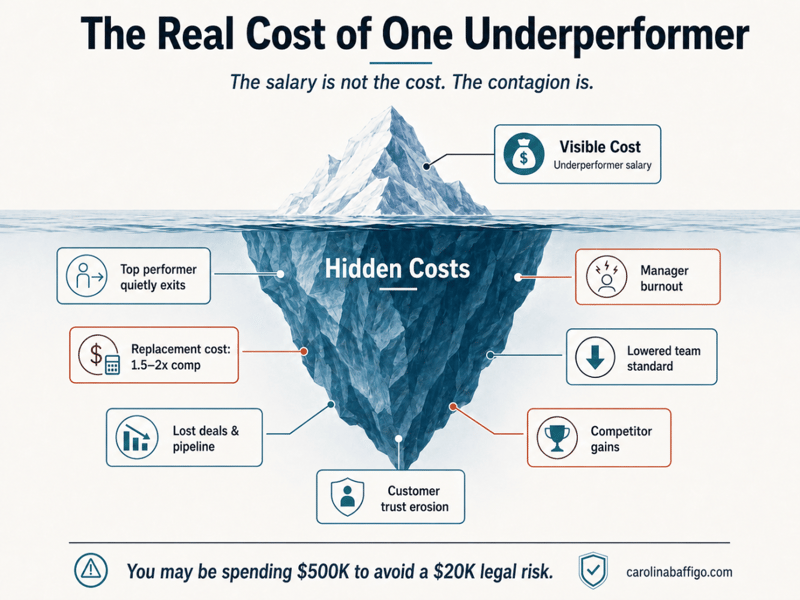
The real cost of one underperformer is not his salary and the severance costs at termination. It is the top performer who quietly updates her resume six months before you ever pull the trigger, and the 1.5 to 2x her annual comp you will spend to replace her, and the deals she would have closed that go to your competitor, who just hired her. It ends up costing a company $500K+ to avoid a $20K-$50K wrongful termination risk.
Your top performer is not the last person to leave. She is the first.
And your customers feel it before HR even files it. They sense decay six to nine months before any internal metric catches up. Your renewals soften. Your pipeline thins. Your CRM finally shows the rot. But by then, HR is just getting started.
I don’t mean to villianize HR here, they're measured on lawsuits avoided, not top-performer retention. The manager is. She gets hit twice when her strongest performer leaves: the team's performance drops, AND her supervisor (maybe also her peers) looks at her like what is wrong with you that the top guy walked. The system that was supposed to protect this manager cost her the people she most needed to keep.
Corporate culture decay operates on a faster clock than the system was built for. A team of six absorbs and normalizes a new standard in weeks. A defensible termination takes quarters, even in a right-to-work state. The faster-moving problem is the one your system cannot see.
So the manager becomes the shock absorber. She picks up the work the underperformer is not doing. She runs interference with the stronger people who are starting to notice, hoping to slow the contagion. She absorbs the emotional labor of the documentation process while she is still expected to hit her own numbers. She burns out. Or she leaves. Or she stops fighting, the team equilibrates to the lower standard, and five years later everyone wonders why they cannot find good people anymore.
They can find good people. The good people are at the competitor, who is growing.
The Wrong Instrument
The problem is not that your underperformer is too hard to fire. The problem is that you are using the wrong instrument. Performance management is a legal instrument. What you are facing is an operating system problem. The two require completely different tools.
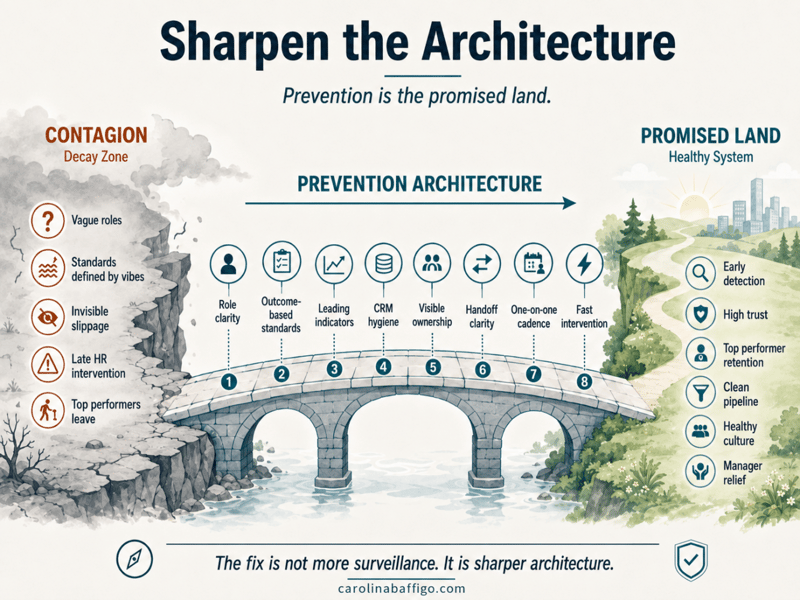
Cultural decay cannot be solved at the moment you notice it. It has to be prevented by a system that surfaces it early, while it is still small, still reversible, still not yet contagious.
The most heretical thing I will say in this piece is that the fix is not better management. It is sharper architecture. In my recent engagements I have watched team after team mistake a people problem for what is actually a clarity problem. Roles defined in vibes instead of outcomes. Handoffs that live in someone's head. RACIs that exist on a slide nobody opens. When you tighten the engine and its tools, decay becomes legible at week two instead of quarter two. In sales teams that means CRM behaviors that predict outcomes (calls made, visits logged, samples delivered, quotes followed up). Role definitions sharp enough that "phoning it in" is visible against a defined standard, not a vibe. A cadence of one-on-ones that reads whether the person is still in the work or has checked out.
You did not need an HR file. You needed a dashboard that already told you.
The managers I know who are burning out right now are good managers handed a broken tool.
The dilemma is not whether to use the tool. The dilemma is whether to keep believing the tool is the job.